الثلاثاء، 8 سبتمبر 2015

App aims to make meditation easy for skeptics


The idea of meditation can be intimidating for beginners.  You know it’s good for you, but you just can’t get into it. Now, there’s a program that aims to make meditating easier— and it’s accessible right at your fingertips.
The app 10 Percent Happier: Meditation for Fidgety Skeptics is based on Dan Harris’s best-selling book. The newsman was a nonbeliever at first, but now he practices meditation daily to focus, minimize stress and be happier.
Harris paired up with mindfulness scholar Joseph Goldstein and Change Collective,  which offers lifestyle courses and coaching, to create the app, a 12-week course to incorporate mediation into your daily life.
Each day, users get a video lesson and guided audio meditation. Plus, a coach will contact you to answer any questions via text message, giving the app a personalized touch.
The 10 Percent Happier app costs $19.99.

الاثنين، 7 سبتمبر 2015

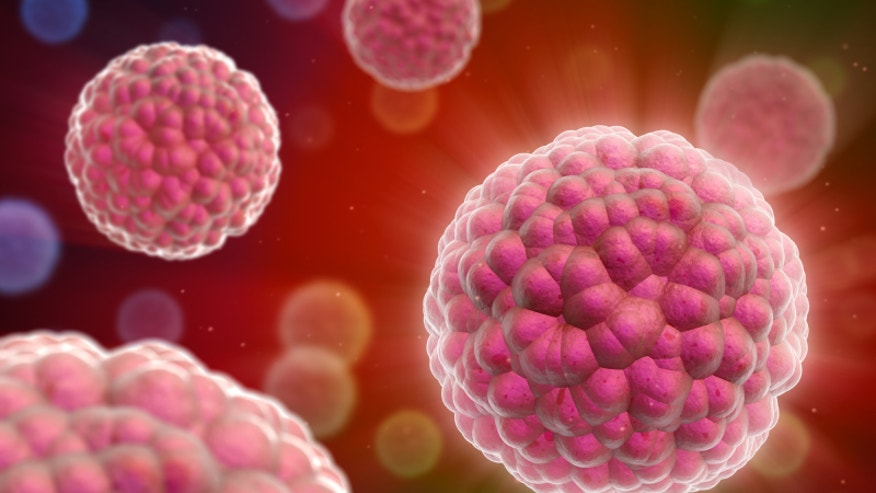
Stem cell discovery could spare cancer patients from nasty side effect


People who have head and neck cancer and undergo radiation treatments often suffer from permanent damage to their salivary glands. This can lead to an inability to make any saliva, the loss of all their teeth and other major consequences for everyday life.
Now, scientists may have figured out how to prevent this harm. They are currently conducting a clinical trial to test their work, they said.
Each year, a half-million patients worldwide with head and neck cancer undergo radiotherapy. About 40 percent of patients who have such treatments suffer major damage to their salivary glands, resulting in dry-mouth syndrome.
"It is painful, causing people to wake up and drink multiple times during the night, leading to severe fatigue," said study lead author Peter van Luijk, a biophysicist at the University of Groningen in the Netherlands. "Speaking and eating is difficult without saliva, and often leads to isolation. Moreover, saliva plays a central role in preventing tooth decay and oral infections. Loss of saliva production often leads to loss of all teeth. These patients often need to use saliva-replacing liquids for the rest of their lives."
Modern radiotherapy techniques use precisely aimed blasts of radiation, in an effort to reduce side effects. However, researchers' understanding of how to prevent dry-mouth syndrome was limited, because it wasn'’t exactly clear how radiation caused this problem, Luijk said.
Scientists had suspected that stem cells inside the parotid glands — the pair of large salivary glands situated just in front of each ear — could help the glands regenerate after being damaged so that patients salivate normally again. Until now, where specifically these stem cells might be located was unknown. [5 Spiffy Facts about Spit]

8 ways to save on dental care costs


Skipping the dentist’s chair, like skipping the doctor’s office when you’re sick, to save money can have major repercussions on both your health and your wallet.
Even if you have dental insurance, your deductible and copayments can quickly add up. But putting off dental care can lead to bigger problems. Left untreated, a small cavity can eventually lead to tooth loss, an abscess to a major infection. Finding ways to get affordable dental care now will save your mouth and your money in the future.
The high cost of avoiding dental care
According to the nationally representative Children’s Dental Health Project Survey released earlier this year, 37 percent of respondents or a relative had avoided dental care in the last 12 months due to cost. But preventive care can identify small and relatively affordable concerns before they become big, expensive problems.
For example, the average cost of a dental exam in San Francisco is $205, according to OKCopay, a medical costs comparison site. If your dentist finds a small cavity on your molar, the average filing price is $160. But if you don’t get regular checkups when that cavity can be found early, it could develop into a bigger problem requiring a root canal, which would cost $825. And that’s if you don’t end up at the emergency room in pain first.

الأحد، 6 سبتمبر 2015

Caffeine close to bedtime does more than keep you up late


It's no news flash that consuming caffeine close to bedtime can interfere with sleep. But scientists at the University of Colorado Boulder report in the journalScience Translational Medicine that caffeine has another physiological impact on sleep by delaying the body's natural surge in the production of the sleep hormone melatonin, which in turn pushes back the body's circadian clock.
"To our surprise, no one had really tested this question," one of the researchers tells NPR. "What we're seeing here now is another way that caffeine impacts our physiology that we didn't know about before in humans." The problem in this case is that the circadian clock is "present in cells throughout our entire body," says the researcher.
"It's in your fat cells; it's in your muscle cells." Messing with it appears to play a role in a wide range of health problems, from obesity to cancer.
Many studies have recently suggested that bright light at night, especially the blue light emanating from our screens, impedes melatonin production. Caffeine's effect is about half what scientists found when exposing volunteers to bright light alone; volunteers who drank a double espresso three hours before bedtime experienced a 40-minute delay of the melatonin surge.
Now the researchers plan to study whether caffeine consumption five or six hours before bedtime produces a similar effect. (Still want to watch TV at night?Orange glasses should do the trick.)

الخميس، 3 سبتمبر 2015

First magnetic wormhole created in lab


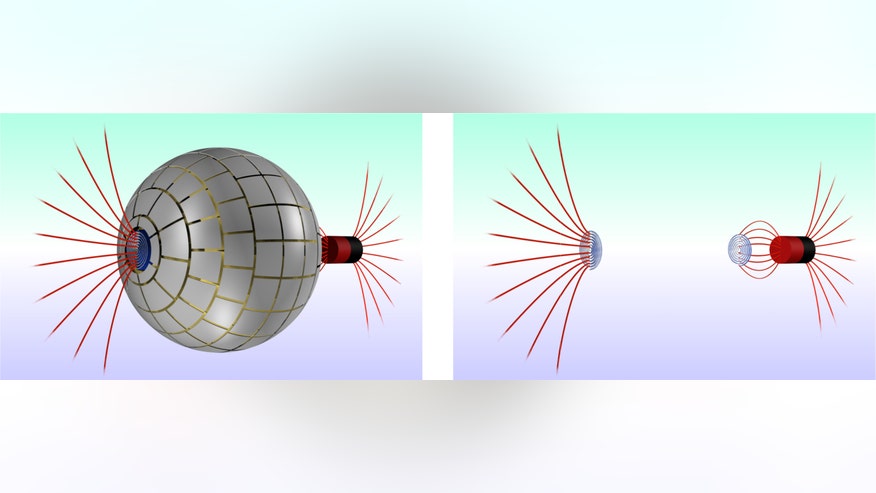
Researchers in Spain have created the first–ever magnetic wormhole in a lab. The specially designed sphere is capable of transferring a magnetic field from one location to another via a process that is magnetically undetectable and only visible by light.
The Autonomous University of Barcelona research team was inspired by the theoretical work of Allan Greenleaf, who, in 2007, introduced the concept of an electromagnetic wormhole that would transfer electromagnetic waves between its ends while the tunnel itself remained electromagnetically invisible. Actually building one, however, proved to be problematic as the materials needed were impractical and hard to work with.
“At a 2013 conference, we met some of the researchers that [came up with] this initial theoretical work and they suggested that we explore whether a wormhole for magnetic fields could be experimentally built,” study co-author and doctoral candidate in physics Jordi Prat–Camps told Foxnews.com. “This inspired us to start this research line. After some intensive research work we realized that the concept was feasible and we developed a magnetic wormhole design that could be realized with existing magnetic materials.”

Unlike the components needed to make an electromagnetic wormhole work, materials required for the magnetic version’s construction were much more readily available– superconductors, for instance, which carry high levels of charged particles and are capable of distorting magnetic field lines.
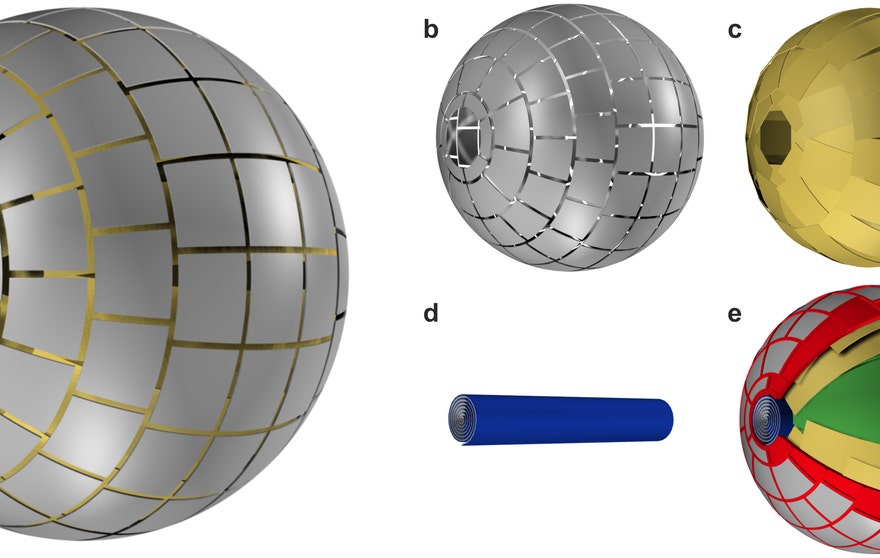
Once they reached a final design, it took about four months to build the actual wormhole and the setup necessary to measure their properties. This work resulted in a three–layered sphere — an outer layer with an iron magnet surface, a second layer consisting of superconducting matter, and finally a ferromagnetic cylinder that passed through the sphere to conduct the magnetic field. By using these metamaterials and metasurfaces to build the cylinder, the researchers were able to take a magnetic field from a source (a magnet or electromagnet) and introduce it to one end of the sphere before it appears at the other end while leaving no trace of the journey in between.
When most of us think of wormholes, we think of the famous gravitational ones that exist in space (as depicted in films like “Interstellar”) which allow anything that enters it to travel instantaneously between long distances. However, those hoping to travel through space and time with this new tech shouldn’t get their hopes up, as the wormhole Prat–Camps and his team have created works a little differently.
“The wormhole we have developed is a spatial wormhole for magnetic fields,” he said. “This means that the device transfers magnetic fields from one point in space to another point through a path that is magnetically undetectable, i.e. as if the transfer was made through an extra spatial dimension. The design only works for magnetic fields and, thus, cannot transfer matter as gravitational wormholes would.”

Ancient human-size fish breathed with lungs


Before the dinosaur age, the coelacanth — a hefty, mysterious fish that now breathes with its gills — sported a well-developed lung, a new study finds.
This lung likely helped the fish survive in low-oxygen, shallow waters hundreds of millions of years ago, the researchers said. During the Mesozoic era, more commonly known as the dinosaur age, it's likely that some species of coelacanth (see-leh-kanth) moved to deeper waters, stopped using their lungs and began relying exclusively on their gills to breathe, the researchers said.
This adaptation to deep water likely helped coelacanths survive the asteroid that slammed into ancient Earth and killed the nonavian dinosaurs, the researchers said. The fish's gill- and lung-breathing relatives were not as lucky; during the Late Cretaceous period, about 66 million years ago, coelacanths living in shallow waters disappear from the fossil record, they said. [See Images of Modern and Fossil Coelacanths]
The hulking 6.5-foot-long fish has long baffled scientists. Fossils of the predatory fish date back to the early Devonian period, about 410 million years ago. The fish was thought to have gone extinct after the dinosaur-killing asteroid hit Earth, but living coelacanths were discovered off the coast of South Africa in 1938.
Today, there are two known species of living coelacanths that live in the deep waters near Mozambique and Indonesia. Scientists have collected and preserved entire specimens of these fish (which give birth to live young) over the decades, allowing researchers to study how the fish change from embryos to adulthood. 
In the new study, researchers examined the curious lungs of one species of coelacanth (Latimeria chalumnae) at five different stages of growth. They scanned each specimen with X-ray tomography, a method that allows researchers to take multiple X-rays of an object, compile them and create a 3D image.
"Our results demonstrate the presence of a potentially functional, well-developed lung in the earliest known coelacanth embryo," the researchers wrote in the study. However, as the embryo grows, its lung development slows, and it eventually becomes a vestigial (functionless) organ in the fish, they observed.
Interestingly, adult L. chalumnae have small, hard, flexible plates scattered around their vestigial lungs. It's possible that these plates are similar to the "calcified lung" of fossil coelacanths, said Paulo Brito, one of the study's researchers and a professor of zoology at Rio de Janeiro State University in Brazil.
"In fossil coelacanths, these plates surrounding the lung most probably had a function in lung volume regulation, moving over each other to accommodate volumetric changes," Brito told Live Science in an email. "In extant [living] coelacanths, it represents a rudimentary anatomical structure.


Committee backs goal of 1 million for US 'precision medicine' project


The initial goal to recruit 1 million Americans to analyze genetic information as part of the government's "precision medicine" initiative was backed in a final report delivered to the National Institutes of Health (NIH) on Thursday.
The "precision medicine" initiative, announced in January by President Barack Obama, will involve a pool of people - healthy and ill, men and women, old and young - who will be studied to learn how genetic variants affect health and disease.
The report, authored by a working group that was created to lay out a blueprint for the initiative, suggested the pool of people to be studied should grow over time. (http://1.usa.gov/1YgI7Lj)
The group outlined two strategies for recruitment.
The first approach is designed to enable anybody living in the United States to volunteer; the second is to collaborate with healthcare providers to recruit participants.
An advisory committee to the NIH is expected to vote on the recommendations later on Thursday.

Twitter Delicious Facebook Digg Stumbleupon Favorites More

 
Design by Free WordPress Themes | Bloggerized by Lasantha - Premium Blogger Themes | Best Web Host